 The New
Astronomy: Chapter 6
The New
Astronomy: Chapter 6
Cover photo: © Tony Hallas
Increasing Image Quality
CCD cameras are extremely sensitive. This is what makes them so ideal for astrophotography. Unfortunately, CCD cameras are also very sensitive to noise. Fortunately, there are several steps you can take to control or remove noise, which enables you to take impressive deep-field images with your CCD camera.
What Is Image Calibration?
- CCD Chips Explained
- Dark Frames Explained
- Flat Fields Explained
- Bias Frames Explained
 Dark Frames
- Are Dark Frames Necessary?
- Taking and Applying Dark Frames
Flat Fields
- Are Flat Fields Necessary?
- Taking and Applying Flat Fields
Bias Frames
- Are Flat Fields Necessary?
- Taking and Applying Flat Fields
Other Tips on Cutting Down Noise
- Sources of Noise
- Dealing with Cosmic Rays
- Combining Darks and Flats
- Lengthening Exposure Times
- Combining Images
- Image Alignment
Image Combining
- Track and Accumulate (SBIG)
- Image Summing/Stacking
- Averaging vs. Median Combine
- Summing vs. Median Combine
- Image Combination vs. Longer Single Exposures
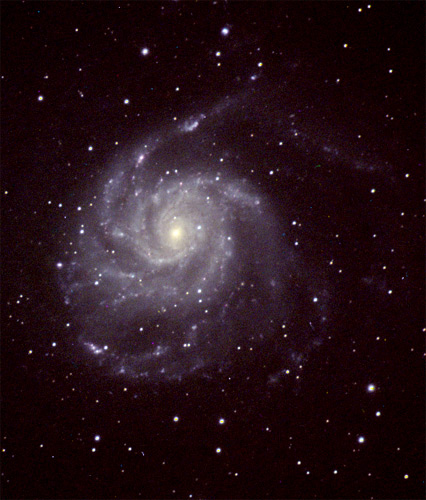
This is one of the most challenging Messier objects to photograph. It has a very low surface
brightness, so it requires a very clean, noise-free image. In the image here, a long exposure
and careful image processing were used to get a clean image.
Image Copyright 2000 by Ron Wodaski