ST-7E First Light July 26, % full moon)
Note: to view all of the detail in these images, you may need to adjust the brightness and contrast controls on your monitor! Generally, increasing brightness will bring out subtle detail.
My setup is an Astro-Physics 400QMD mount, with encoders and a JMI NGC-MAX computer. I set up most often in my back yard. There is serious light pollution to the west (Seattle and Bellevue, WA), but reasonably suburban skies to the south and east. The north is blocked by tall cedar trees, so I usually polar align by using the drift method.
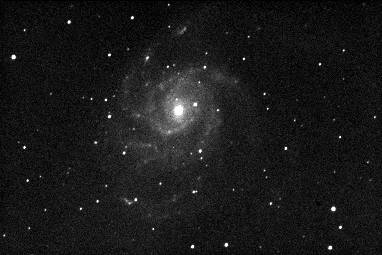
M101, July 26, 1999
ST-7E, 2x2 binned, Takahashi FS-102 120 seconds
I usually start with a 15 second exposure, and a 15-second delay during which I adjust the mount in altitude and azimuth. It typically takes about 20 minutes to polar align this way, but it's the only way I can do it! With experience, I hope it gets smoother and faster.
The image at right is close to raw data, improved only for contrast. The next image below right has had a Lucy-Richardson deconvolution applied using CCDSharp from SBIG.
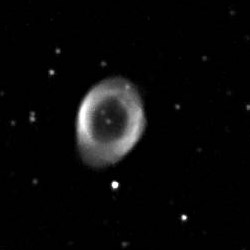
M57, July 26, 1999
ST-7E, Celestron C8 90 seconds
The image at bottom right had a different deconvolution applied, the Maximum Entropy deconvolution in Maxim/DL image processing software. This image isn't as tack sharp, and the fine details (such as the star I pointed out above) are not so crisp here, though (sort of) visible. At the same time, more subtle kinds of detail are preserved.
Which kind of deconvolution is best? Hard to say from this example; each has its merits.
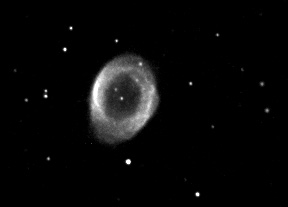
M57, July 26, 1999 - Lucy Richardson deconvolution applied
ST-7E, Celestron C8 90 seconds
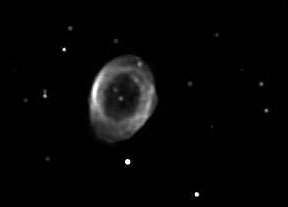
M57, July 26, 1999 - Maximum Entropy deconvolution applied
ST-7E, Celestron C8 90 seconds