|
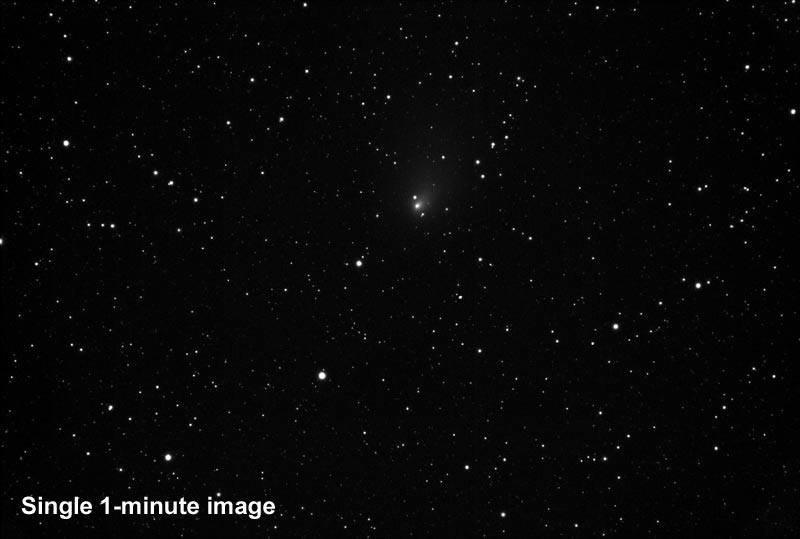
The image above is of comet WM1/LINEAR taken in the early
morning hours of 11/10/2001. I took a total of 21 such images. Some tips
on individual comet exposures:
- The exposure should be short enough not to show any trailing of the
comet at whatever focal length and image scale your are using.
- Exposures of 30-90 seconds are usually safe for typical image
scales. Experiment to find the longest exposure you can use. The
longer your exposure, the better in most cases. The closer the comet
is to earth, the faster it moves and the shorter your exposure has to
be to keep both stars and comet nucleus round.
- Some mounts, like the Paramount, can track accurately on the comet's
motion. However, this will trail stars instead of the comet if allowed
to go too long. Here is a five-minute image of WM1/LINEAR that uses
this technique.
|